

Remember studying different forms of government in History or Social Studies class in high school? I don’t recall the year, the class, or the teacher, but I do remember hearing about:
- Democracy
- Communism
- Socialism
- Fascism
- Dictatorship
- Monarchy
- Feudalism
- Benevolent Despot
Of course, the students agreed that democracy was the way to go. In the 1960s in the U.S., that seemed very clear. Democracy gave power and freedom to the people, and the U.S. form of democracy provided for checks and balances to prevent any branch of government from becoming too powerful. The founders did not form a true direct democracy (think ancient Athens) but rather a representative democracy. About 15 years after the Constitution was created, the Electoral College was added, a point of contention for some today. However, overall, the Founding Fathers learned from history and got many things right. One could make a strong argument that they created a better Constitution than any before or since.
For the past 80 years, almost everyone in the country has accepted without much debate that Democracy is the best form of government. The U.S. has even fought wars and contributed vast amounts of foreign aid, trying to spread democracy to other countries.

Lately, some observers have wondered whether U.S. democracy is all that great. The country has perhaps never been so polarized, split just about 50-50 into warring camps with completely different visions for the future.
Winston Churchill, known for his witticisms, famously said, “No one pretends that democracy is perfect or all-wise. Indeed, it has been said that democracy is the worst form of government except all those other forms that have been tried from time to time.”
Karl Marx, not known for his witticisms, believed that Democracy had a short shelf life. He predicted that the oppressed would eventually rise up and overthrow their oppressors. In his day, the oppressed were those who worked in factories under poor working conditions and for long hours, and the oppressors were the owners of the factories, the capitalists. After the overthrow was complete, as the story goes, the factory workers would take over the factory and share in the profits. Karl’s vision has never been realized. A few countries have paid lip service to Karl’s philosophy, but it always turns out that the leaders of these countries get rich while the poor get even poorer. Irving Berlin, the composer, once said something like “the world would be a better place if Marx had been Groucho rather than Karl”. Maybe then everyone in Russia and China would be playing You Bet Your Life.
Today in the U.S., we are seeing signs of Marxist thinking. Depending on who is talking, the oppressors are rich people or old, balding white men born in the 1940s and 50s. The oppressed are poor people or people of color or poor people of color. According to some, all problems can be directly or indirectly traced to Jeff Bezos, Bill Gates, or Elon Musk or, of course, to the previously mentioned group of old white men.

Could it be that Marx (i.e., Karl) was right? Has democracy been played out? At least in the U.S., there are some obvious flaws in our form of democracy, which appears to be heading for a crisis of some sort.
The Two-Party System. A high percentage of the country is firmly entrenched in its political party. Only a small minority of voters register as Independent and vote for the candidate they judge to be best from either the Democratic or Republican ticket. For well-established Dem and GOP voters, their candidate could stutter and stand as if entranced during a debate, and they’d still pull the D or R lever without a second thought.
What causes voters to become so fixed in a political party, sometimes for life? Experts say there are a few reasons:
Personal Identity – A person’s political party becomes part of how they define themselves, like their family situation, religion, and profession. Someone might say, “I’m a Democrat, my parents were Democrats, and my grandparents were Democrats.”
Once established, a voter is likely to stay with their party. That’s at least partly due to information filtering or confirmation bias. People who identify strongly with a party tend to interpret new information in ways that support their existing views. Therefore, new information tends to be reinforcing rather than cause new thinking.
Party members tend to describe their party in a positive way that supports their choice. For example, people may believe that Democrats support the underdog and are, therefore, kinder people. Democrats are more highly educated. Democrats want the government to play a larger role in providing social services, and so on. These self-perceptions may not be completely accurate, but they are reinforcing.
Regional, Religious, and Media Influences – On national election night, major networks show maps of the country by county. The commentators know precisely how each county usually votes, and they tend to be relatively consistent. For example, most major urban areas are led by Democratic mayors and vote Democratic in Presidential elections. This could be because of the higher percentage of ethnic or LGBTQ minorities in cities, because of the presence of universities, which tend to be liberal, or because of a smaller percentage of people involved in organized religion.
Indeed, religion plays a role. A significant percentage of Evangelicals and Catholics vote Republican. More Jews, Muslims, Buddhists, and those unaffiliated with a religion vote Democrat.
The liberal and conservative groups have their own news and television networks that selectively report reinforcing stories and spin all covered stories to conform to the accepted dogma. The major newspapers, like the New York Times, LA Times, and Washington Post, lean left, as do the major television networks. Fox News and NewsMax lean right.
Because of psychological biases, strong political beliefs tend to be self-reinforcing. When facts threaten the identity of the party (“my side did something bad”), people experience psychological threat and work hard—often unconsciously—to defend the group rather than update their beliefs. Even when people clearly see that their party is wrong, they tend not to admit it. Disagreeing with their party feels like betraying family; defending the party becomes an emotional reflex rather than a considered judgment.
For these reasons, a vast majority of Democrats and Republicans stick with their party come hell or high water. Only a small minority deviates from the Party Platform. One current example is Sen. John Fetterman from Pennsylvania. He has gone against the majority of his party on several occasions, most recently supporting Israel’s conflict with Hamas.
Warring Parties. The great majority of party representatives are primarily interested in winning the next election, which means they need to raise funds, stay close to their party and its talking points, and do nothing that would alienate the electorate. Winning the next election could mean undermining any programs put forth by the other party, regardless of how beneficial they may be. Defeating the adversary—that’s the dysfunctional objective.
The two-party system, once lauded as a feature of democracy, now seems to have become its central problem. The country cannot fix problems or make progress unless one party oversteps its authority through an executive order or otherwise.
Our system is broken.
U.S. Short-Termism vs China’s Long Game. With Presidential elections every 4 years and Congressional Representatives up for election every 2 years, politicians and their parties spend much of their time positioning themselves and raising money for the next election.
With cable news and Internet outlets like Facebook and Twitter, the press carries significant clout and accentuates the emphasis on the short term.
China, our main adversary, has made great economic progress over the past 30 years, implementing five-year plans drafted by some of its brightest minds. The plans lay out in detail how China will advance technology, global trade, and global influence over the coming five years and longer. For example, China’s Belt and Road Initiative has increased trade and influence worldwide, benefiting the home country. In contrast, the U.S. has great difficulty passing even a one-year budget.
Many have proposed term limits on Senators and Congressmen to address the country’s short-term orientation. Since a term-limit law would need to be passed in the Senate and House, any bets on the likelihood?
We are losing to China in some key areas of competition because of our two-party system and short-term orientation.
Voter Ignorance. Most U.S. voters are not well-informed. In fact, most voters are not very smart. It comes with the democratic territory. In a recent article in The New Yorker Magazine, the author noted:
Roughly a third of American voters think that the Marxist slogan “From each according to his ability to each according to his need” appears in the Constitution. About as many are incapable of naming even one of the three branches of the United States government. Fewer than a quarter know who their senators are, and only half realize that their state has two senators.
Then there’s the bell-shaped curve problem. What percentage of the population is smart enough to vote? I’ve never seen a study on that subject. The guy who entered the Capitol building wearing a bison hat comes to mind. He may not be very bright, or as a schoolteacher might say, “he just exercised very poor judgment” (especially in his sartorial choices).
Listening to some politicians, everyone should vote, whether they care about voting or can read or write. Indeed, community organizers complete mail-in ballots for many uninterested but eligible voters while adding the enticement of a Krispy Kreme or Big Mac. It’s a bit corrupt and not good for cardiovascular health.
Those who don’t care about voting are perhaps more rational than individuals who spend time analyzing and arguing about politics as a sort of a hobby. After all, what’s the likelihood that one person’s vote will be the deciding factor in an election? It’s about the same as the probability of hitting Powerball two months in a row.
Some very smart-sounding academic authors have addressed voter ignorance and proposed solutions, such as literacy/intelligence tests. Yikes, I think proposing that on Twitter may be dangerous. At the very least, you’d be called a bunch of names that end in “ist”.
John Stuart Mill, a British economist and philosopher widely regarded as having one of the highest IQs ever recorded, believed that Oxford- and Cambridge-educated people should be able to vote multiple times. In fact, that notion was similar to a law that existed in England in the early 20th Century. Multiple voting still occurs in the U.S. today, even though it has nothing to do with Oxford or Cambridge and is illegal.
In a new book, “Against Democracy”, Jason Brennan, a political philosopher at Georgetown, argues for epistocracy (or rule by the knowledgeable). Brennan argues that it’s entirely justifiable to limit the political power that the irrational, the ignorant, and the incompetent have over others
The problem with these ideas, as attractive as they may sound, is deciding who is ignorant, irrational, or incompetent, and likewise, who is knowledgeable. A competency test may work, but we’ve already decided that would be politically unacceptable. Maybe a panel of the smart, informed, rational, and competent could determine who should be allowed to vote. Nah! Those who score high on aptitude tests may not be very wise. A high percentage of Mensa members are reportedly unsuccessful at life.
So, there seems to be no practical solution to this problem. We are stuck with a system in which a significant percentage of votes are cast by people on the left side of the distribution who don’t know how many states there are in the U.S. or how many senators represent their state. On the other hand, anecdotal evidence suggests that even very bright people are not better voters. We’re stuck with a voting system that produces many dumb choices
The Animal Farm Problem. Remember reading ‘Animal Farm’ by George Orwell? A group of disgruntled animals decides to take over the farm to form an egalitarian society in which all animals are equal. However, it didn’t work out that way. The pigs took control and became ‘more equal’ than the other animals. Once they had control, they forgot about the egalitarian idea.
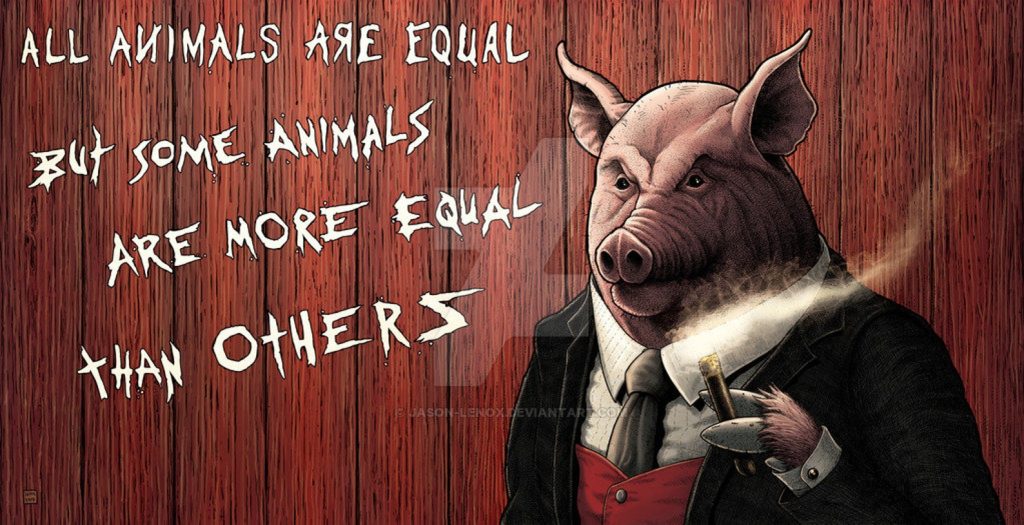
Every form of government seems to be riddled with corruption. Certainly, Putin, Xi Jinping, and Castro are corrupt. At least they became very rich while serving in their respective communist parties. Aren’t communists supposed to be poor? Is there no such thing as a good communist anymore? I think Woody Allen said, “Communism is like a nude beach. The idea is much more attractive than the real thing.”
The more powerful a politician is, the more likely they are to be corrupt. Come to think of it, has there ever been an honest dictator?
The ‘more power, more corruption’ principle seems to apply to politicians in democracies, too. For example, think of Mayor Daley, Boss Tweed, and Richard Nixon; the list could go on for a few pages, including members of both parties. Power creates temptation because powerful people know no one is looking over their shoulder, which makes it more tempting to take a cookie. The powerful know that if an underling squeals on them, they can fire the plebe or transfer them to the branch office in South Dakota.
In the U.S., the press is supposed to keep politicians honest, but they have not done a good job lately. The days of Walter Cronkite are over. Polls show that the press is no longer well respected either.
The Ben Franklin Problem. Benjamin Franklin is credited with saying, “When the people find that they can vote themselves money, that will herald the end of the republic.” The people have already figured that out, so are we nearing the end of the republic? Only about half of voters pay federal income tax. The rest are taking more than they are giving.
Industries and professional groups that donate to political parties and election campaigns also approach the government seeking grants or tax breaks. In contrast to Ben Franklin’s observation, this phenomenon could be called leveraging favors from the government. In some cases, it is equally destructive to the republic.
Possible Generational Conflict. Economic problems could be attributed to capitalism rather than democracy, but they are intertwined, as we have observed. Wealthy corporations and individuals have an outsized influence on our democracy because politicians depend on contributions from wealthy donors.
The national debt, which now stands at an astounding $38 trillion, is a quantification of the problem. Growing at $2 trillion per year, the debt is unsustainable, and the burden will fall most heavily on younger people.
The distribution of wealth is another measure of brokenness. The top 1% of households now hold a record share of wealth. A few politicians have suggested a tax on wealth to transfer wealth from the upper to the lower classes. France tried this, and wealthy individuals fled the country.
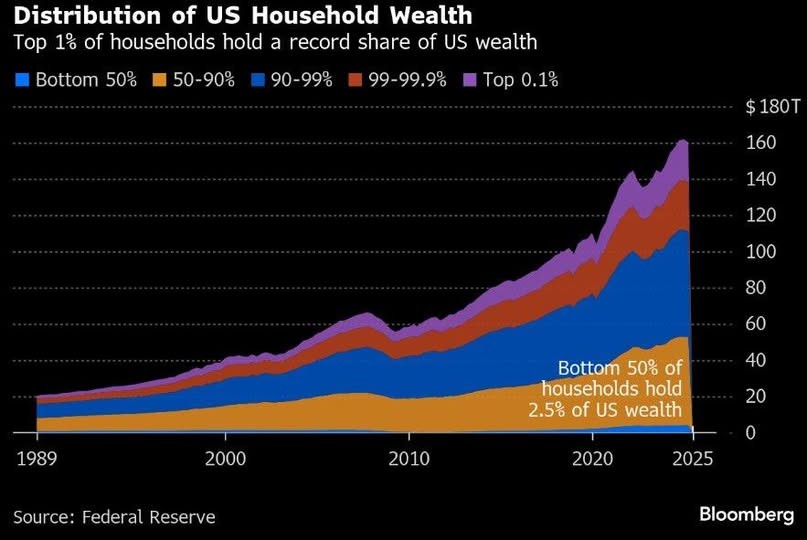
Although the top .1% of wealth is held by billionaires, the top 1% and top 5% is held by older individuals. As the debt grows, the Government will have to find funds. Older households are likely sources.

Younger people are facing challenges such as student loan debt that exceeds their repayment capacity and unaffordable housing prices. As artificial intelligence and robotics are used to handle many jobs, things may only get worse.
Is a generational struggle brewing? It very well could be.
Democracy is Broken. We may be witnessing the end of our democracy’s shelf life.
* Hardened, warring voting blocks
* Self-serving politicians
* Uninformed voters
* Short-termism
* The Animal Farm Problem
* The Ben Franklin Problem
* Severe economic problems
* Generational conflict
What could possibly save us from this downward spiral? Marx was partly right, but he had the storyline wrong. Sadly, our democratic system appears to be a victim of its own success.
Social Studies Redux: Let’s go back to that History class you took 50 or more years ago. I wonder if students who take similar courses today all agree that democracy is best. I wonder if teachers today think democracy is best. I wonder if voters still think democracy is best.
Actually, I think we may be able to design a better system based on what we may have learned from this humble essay. The leaders of China seem to be smarter than our leaders. They are not very charitable, but at least they make good decisions for China. They don’t have to worry about beating the other party because there is no other party.
The downside of the Chinese system is that, like ours, it’s corrupt. The leaders enrich themselves. They don’t accept challenges from the people and deal harshly with deviations from the party line.
Maybe we need a system in which the leaders are already rich, so they don’t have to manipulate policy to get more money for themselves. You know, like having Jeff Bezos, Elon Musk, Michael Bloomberg, or Larry Ellison as the leader. They’ve managed their companies very well and made themselves very wealthy. How about picking one of them to lead the country?
But we need a leader who is not only intelligent and wise but also kind, someone who cares about people.
And, we need a leader who follows and enforces the law.
So, it seems that we are converging on a new system. It must have these attributes:
- A single political party – so we make decisions to help the country rather than defeat the other party.
- Smart, proven leader(s) – so they make good decisions.
- Wealthy leader(s) who don’t try to enrich themselves.
- Leader(s) who are kind-hearted, not mean – so they see their job as serving the country and the people.
This sounds a lot like the Benevolent Despot model from high school.
Hmmm…But, before I fully commit to Benevolent Despot, I’d like to do another Google search on the word “despot”. It sounds too similar to “desperate”.
References
The Case Against Democracy | The New Yorker
Criticism of democracy – Wikipedia
Democracy Is for Losers – American Consequences
Americans Remain Distrustful of Mass Media (gallup.com)
 The Ordinary Blog