
A closer look at the demographics, economics, and politics behind DSA’s rising influence
Recent elections suggest the American political landscape is shifting. Democratic socialist ideas have gained influence inside the Democratic Party. A growing number of progressive candidates—including several Muslim elected officials—have won office, and conservatism has lost ground in many urban areas and among younger voters.

The Democratic primary victory of Abdulrahman Mohamed El-Sayed for the U.S. Senate in Michigan is one illustration of this broader trend. Although El-Sayed is not a member of the Democratic Socialists of America (DSA), many of his close political associates are. For example, Hassan Piker, a close associate, was quoted as saying Americans deserved 911. Although he retracted the statement later, that fact alone makes the organization’s growing reach worth examining.
As Kim Strassel writes in the WSJ, “Mr. El-Sayed’s agenda is in lockstep with that of Sen. Bernie Sanders: Government-run healthcare, an end to border enforcement, wealth confiscation, hatred for Israel, climate alarmism, structural changes aimed at influencing Supreme Court outcomes, free government everything.”
What the DSA Advocates

The DSA and its aligned elected officials and activists have advanced a wide range of proposals that would substantially restructure American government, the economy, and social policy. The positions below are drawn from DSA platforms, caucus materials, and statements by prominent members. Not every DSA member endorses every item, but the overall direction is clear:
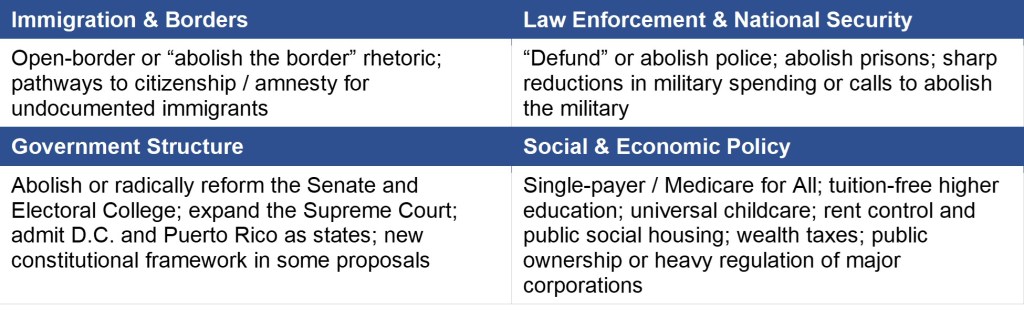
Taken together, these ideas would move the United States toward a far more centralized, redistributive model of governance. Critics argue they would erode core institutions—borders, policing, private enterprise, and the current constitutional balance—that have underpinned American prosperity and stability.
Leadership and Demographics
A noticeable share of DSA-aligned elected officials and candidates are first- or second-generation immigrants, and several high-profile figures are Muslim. Prominent names frequently cited in this context include Rep. Ilhan Omar, Rep. Rashida Tlaib, Rep. Alexandria Ocasio-Cortez, New York mayoral figure Zohran Mamdani, and others such as Francesca Hong, Nithya Raman, and Darializa Avila Chevalier.
This pattern is observable, but it is important not to over-interpret it. Political movements often draw energy from particular ethnic, religious, or immigrant networks; the more consequential question is the substance of the agenda these leaders advance.
Of concern, is that some DSA members express distaste not only for American economic and political systems, but also the American culture. For example, Francesca Hong, who is running for governor of Wisconsin said in a blog post that she wanted to cancel the Thanksgiving holiday because it is a celebration of colonialism.
Peggy Noonan writes in the WSJ, “Most (DSA candidates) strike me not as people who love America and wish to make it better, but people ready to exploit its freedoms…”
Shifting Attitudes Among Younger Voters
Polling data show a clear generational shift:
- Gallup has documented a decline in favorable views of capitalism, with younger cohorts driving much of the change.
- Surveys have reported that roughly 60 percent of young Americans now view socialism favorably.
- About 65 percent of American voters say the economic system is “rigged” in favor of the wealthy.
- Roughly one in three Democrats now identify as democratic socialists; a majority of them are under 45, and many report higher-than-usual motivation to vote.
“Subaru Socialists” and the Great Disappointed
A recent New Yorker piece described a cohort of people in their twenties, thirties, and forties—often labeled “Subaru Socialists”—who expected greater prosperity than their parents yet find themselves stuck. Many come from upper-middle-class households, attended college (and frequently graduate school), and still feel underemployed. A common vignette is the sociology master’s graduate managing a Starbucks while carrying substantial student debt. They are not merely disappointed; they are angry that the traditional path to prosperity appears broken.
Data on DSA voters in New York City reinforce this picture. The modal DSA voter tends to be white, college-educated (often with a graduate degree), from a relatively privileged family background, yet currently earning modestly—frequently in the $30,000–$60,000 range. Relative to years of education, many are underachieving economically. Interesting that women lean more heavily toward the DSA than men.
This demographic profile is not new. As a Wall Street Journal essay observed, Karl Marx and Friedrich Engels themselves were young men from comfortable backgrounds when they published The Communist Manifesto in 1848. Marx’s father was a successful lawyer; the family owned vineyards and rental properties and employed servants. Marx spent more time drinking than studying at university in Bonn before transferring to Berlin, where he continued to rack up debts. Engels later supported Marx financially for the rest of his life.
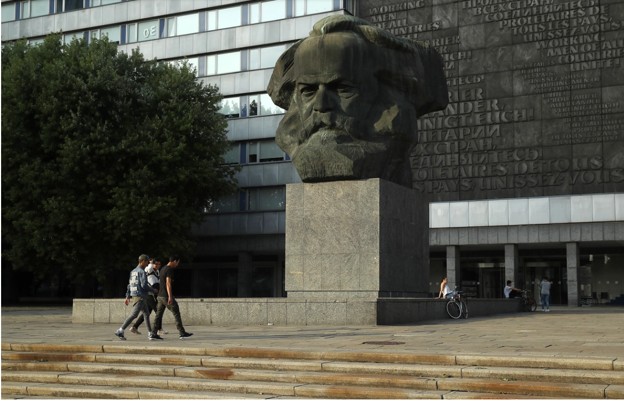
Economist Thomas Sowell noted the recurring pattern: “The offspring of privilege have dominated the leadership of Marxist movements from the days of Marx and Engels through Lenin, Mao, Castro, Ho Chi Minh, and their lesser counterparts around the world.” The appeal of radical egalitarianism to those who feel their own credentials have not delivered expected status is a durable feature of left-wing politics.
Why Socialism Is Gaining Ground Now
Most observers across the spectrum agree that economic conditions are a primary driver. Prolonged periods of slow growth and diminished mobility have historically fueled movements promising sweeping change—whether on the left or the right. Examples range from interwar Germany and Italy, to Russia before the Bolsheviks, China under Mao, Cuba under Castro, and Venezuela under Chávez. In the United States, communist and socialist ideas gained traction during the Great Depression. Something analogous, though milder, is visible today.
Slower Economic Growth
U.S. economic growth has decelerated. A recent Wall Street Journal analysis summarized the long-term shift:
Between 1950 and 1974, the U.S. economy grew at a compound annual rate of 3.8 percent after inflation. Over the next quarter-century, the rate was still 3.2 percent. Real GDP grew at 4 percent annually during Bill Clinton’s presidency. But in the 25 years beginning in January 2001, the annual growth rate fell to roughly 2.1 percent—and recent quarters have continued near that subdued pace.
When growth is slow, the wealthy capture a larger share of incremental gains, intensifying resentment even if absolute living standards continue to rise for many.
Global Competition and Offshoring
Business cycles and technology matter, but the most straightforward structural change is intensified global competition. In the 1950s and 1960s the United States faced limited foreign competition in many industries. Today competition—especially from China—is intense, and globalization has shifted large numbers of jobs offshore. The result is fewer middle-skill opportunities and slower wage growth for workers without scarce technical skills.
Political Polarization and the Trump Foil
Political dynamics amplify the trend. The American electoral pendulum often swings hard in one direction before correcting. President Trump’s persona, rhetoric, and policy choices supply the left with ready-made rallying points. Unpopular foreign-policy developments further energize progressive mobilization. The result is a strong pull toward the left among younger and urban voters.
Artificial Intelligence and Near-Term Disruption
Artificial intelligence is likely to intensify these pressures in the short and medium term. Many jobs will not disappear entirely, but large portions of them can be automated, reducing headcount. The near-term effects are higher unemployment or underemployment in affected sectors, slower wage growth, and greater demand for government assistance. In the longer run, some technology leaders (including Elon Musk and Bill Gates) envision a world of abundance in which AI and robots handle most labor and societies move toward some form of guaranteed income and shorter workweeks. Whether that utopian endpoint arrives, the transition period itself is likely to be turbulent—and fertile ground for political movements that promise protection or redistribution.
Outlook: The Next Five to Ten Years
As noted earlier, economic growth of 4% or more, as was experienced after WWII and intermittently until the year 2000, could reverse this trend. Although that is a possibility, currently there are no obvious signs of sustained improvements in GDP growth.
The Likely Political Trend
Many analysts have wondered whether this shift to the left is a temporary trend that will last only a few years or a more permanent change in American politics. Several factors suggest this move is more permanent. For example, the growing national debt will eventually cause the government to raise taxes, and higher taxes will have a contractionary effect on the economy and job creation. Also, as just mentioned, AI will tend to reduce job creation and cause loss of some existing jobs. So, it appears that the economic factors fueling DSA growth will continue.

If the DSA Agenda Gets Adopted
Even if DSA-aligned candidates continue to win primaries and seats, the full radical platform is unlikely to be enacted. It remains too far outside the preferences of most voters and most elected Democrats. A more plausible path is a moderate-left drift that incorporates selected elements: higher taxes on wealth and corporations, expanded single-payer or public-option healthcare, tuition-free or heavily subsidized higher education, expanded childcare, more permissive immigration enforcement, procedural changes (filibuster reform, court expansion, statehood for D.C. and Puerto Rico), and reduced relative funding for policing and the military.
Critics of this trajectory warn that such changes could lock in structural advantages for one party, raise the tax burden enough to further slow growth, and reduce opportunities for upward mobility—the very problem that is already feeding discontent among the young and educated. Attempts to extract large amounts of wealth from billionaires would face capital flight; retirement accounts held by ordinary savers could become more attractive targets. The resulting system would look less like classic social democracy and more like a politically connected, highly centralized model in which opportunity depends heavily on proximity to power.
Whether that future materializes depends on growth rates, the pace of technological disruption, the quality of opposition politics, changes in college programs, and voters’ willingness to trade institutional continuity for promises of security and free services. The rise of the DSA is best understood not as a sudden ideological conversion but as a predictable response to slowed mobility, poor educational choices, and a political culture that rewards radical signaling.
Sources:
Economics Drive Populism and Socialism – WSJ
Socialists May Prove Surprisingly Strong in November – WSJ
Subaru Socialists and the Great Disappointed | Gazer Daily
A Future Without Work? What Elon Musk and Bill Gates Are Saying – Business Insider
Image of Capitalism Slips to 54% in U.S.
Socialism Is Here—and It’s Serious – WSJ
 The Ordinary Blog